What are the ways to sell a house in Nevada?
There are four realistic paths: take a direct cash offer, fund a renovation and sell on the retail market, have your existing financing taken over, or list with a local agent. Each one trades speed against price in a different way. Which one nets you the most depends on the condition of the house, how much equity you have, and how much time you actually have.
Sell My House NV reviews all four with you before recommending anything. Sometimes the honest answer is that you should list rather than sell to us, and we would rather tell you that than buy a house you should have taken to the market.
The Four Options Side by Side
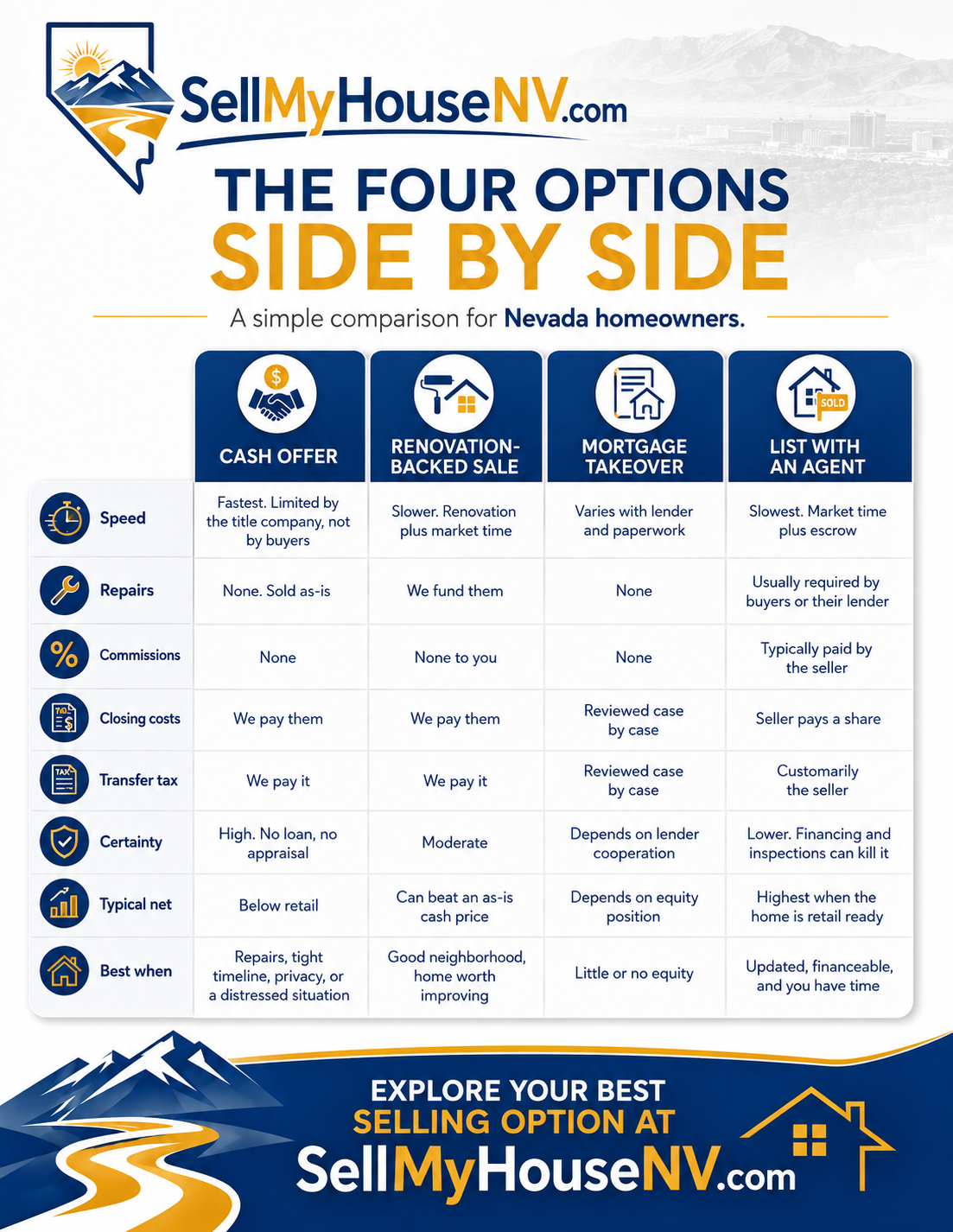
In short: a cash offer is the fastest and most certain path, sold as-is with no commissions and with closing costs, transfer tax, and title insurance paid by us, and it nets below retail. A renovation-backed sale takes longer but can beat an as-is cash price on the right home. A mortgage takeover applies mainly when equity is thin. Listing with an agent usually nets the most on a retail-ready home, and costs you commissions, a share of closing costs, the transfer tax by custom, repairs, and time.
Option 1: A Direct Cash Offer
We buy the house ourselves, in whatever condition it is in, and you pick the closing date. No lender means no appraisal, no financing contingency, and no buyer backing out because their own house did not sell. That is where the certainty comes from.
What it costs you: the price is below retail. It has to be, because we absorb the repairs, the holding costs, and the risk that you would otherwise carry. What you get in exchange is speed, certainty, and the ability to walk away from a property without touching it.
Best when: the house needs work, the timeline is being set by something outside your control such as a recorded notice of default, the property is tenant-occupied or vacant, or you simply do not want showings and strangers walking through your home.
Option 2: A Renovation-Backed Retail Sale
For certain homes in strong neighborhoods, the gap between as-is value and renovated value is wide enough to be worth capturing. In that case we fund the renovation and the home sells on the retail market rather than to us at an as-is price.
What it costs you: time. The renovation has to happen before the home lists, and the market has to cooperate afterward. This option also requires underwriting approval and is not available on every property.
Best when: the home sits in a neighborhood where updated houses clearly command more, the bones are sound, and you are not on a hard deadline.
Option 3: A Mortgage Takeover Review
If you owe close to what the house is worth, a traditional sale can leave you writing a check at closing instead of receiving one. In some of those cases a structure where the existing financing stays in place can be reviewed as an alternative.
What it costs you: complexity, and real trade-offs. This is the option with the most moving parts and the one that deserves the most scrutiny. If we discuss it, we will put the risks, the documents, and the timeline in front of you in writing, and you should have your own attorney review it before you sign anything.
Best when: equity is thin or negative and the alternative is bringing money to closing or letting the property go to a trustee sale.
Option 4: Listing With a Local Agent
If the home is updated, financeable, and likely to show well, the retail market will usually beat a cash offer even after commissions and holding costs. When that is the case we say so, and we can point you toward a local agent instead of buying the house ourselves.
What it costs you: commissions, part of the closing costs, the transfer tax by custom, repairs the buyer or their lender requires, and the time the whole process takes. It also carries the least certainty, since financing and inspections can undo a deal weeks in.
Best when: the house is retail ready and you have the time and the tolerance for a traditional sale. Whoever you list with, verify their license first through the Nevada Real Estate Division.
Which Option Fits Your Situation
- A notice of default has been recorded. The calendar is set by statute, not by you. Speed matters more than squeezing out the last few percent. See selling a house facing foreclosure in Nevada.
- The house came through an estate. Probate changes who can sign and when. Cash usually fits, but the timeline runs on the court, not on the buyer.
- There is an HOA lien. Nevada associations hold a super-priority position for nine months of assessments, which changes the payoff math. This is worth sorting out before choosing a path.
- You live out of state. Any of the four can work remotely, but listing means managing repairs and showings from a distance.
- The home is updated and financeable. Listing likely nets more. We will tell you so.
- Equity is thin. A traditional sale may cost you money at closing. That is where a takeover review belongs in the conversation.
What Each Option Actually Costs in Nevada
Price is not the same as net. In a traditional Nevada sale the seller typically absorbs agent commissions, a share of closing costs, the owner’s title insurance policy, and the real property transfer tax collected by the county recorder when the deed records. In Clark County that tax runs $2.55 per $500 of value, and in Washoe County $2.05 per $500.
On a cash sale to us, we pay the closing costs, the transfer tax, and the title insurance, and there are no commissions because there is no listing. Comparing a listing price against a cash price without subtracting those items makes the listing look better than it is. Ask us to run both numbers side by side and we will.
How We Compare the Options With You
We research the property, pull the recorded documents, and look at what comparable homes in your neighborhood actually sold for. Then we show you what each path is likely to net and how long each takes. The full sequence is laid out on how we buy houses in Nevada. Nothing is owed for the analysis, and there is no obligation attached to any of it.
Where We Buy in Nevada
Our office is in Henderson and we work across southern and northern Nevada, including Henderson, Green Valley, Las Vegas, North Las Vegas, Summerlin, Summerlin South, Spring Valley, Paradise, Winchester, Reno, Sun Valley, and the Nevada side of Lake Tahoe.
Frequently Asked Questions About Comparing Your Options
What is the fastest way to sell a house in Nevada?
A direct cash sale, because there is no lender, no appraisal, and no financing contingency. The remaining limit is how quickly the title company can clear title and fund, which is why we do not publish a fixed number of days.
Will a cash offer be the highest price I can get?
Usually not. A cash offer trades price for speed, certainty, and no repairs. If the home is retail ready and you have time, listing normally nets more even after commissions.
What is a renovation-backed retail sale?
We fund the renovation and the home sells on the retail market instead of to us as-is. It requires underwriting approval and it is not available on every property, but where it fits it can be worth more to you than an as-is price.
What is a mortgage takeover?
A structure where the existing financing stays in place rather than being paid off at closing. It applies to a narrow set of situations, mostly where equity is thin, and it carries real trade-offs that should be reviewed with your own attorney.
What if listing with an agent is better for me?
Then we will tell you that and can refer you to a local agent. We would rather be the company that gave you the straight answer than the one that bought a house you should have listed.
Do I have to pick an option before contacting you?
No. Most sellers do not know which path fits until they see the numbers. Comparing them is the first conversation, not the last.
Does it cost anything to have you review my options?
No. There is no fee for the analysis, no obligation attached to any offer, and no charge if you decide to do nothing.
Compare Your Options With Sell My House NV
Get An Offer Today, Sell In A Matter Of Days
Send us the address and we will research the property and come back with the paths that actually apply to it, in writing. You can also call (702) 208-2434 or request a cash offer here. If you want to know who you are dealing with first, read about our company.
Our Priority Markets
We buy anywhere in Nevada. These are the communities we work in most often.
Written by Kyle Newman, a second-generation real estate professional with family in the industry since 1977. Last updated August 14, 2026. Sell My House NV is a tradename of United Homes of America LLC, a Nevada-registered company founded in 2015. Sell My House NV is a home buyer, not a law firm or a licensed Nevada brokerage, and nothing on this page is legal or tax advice. County rates and statutes change, so confirm anything that affects your decision with the county recorder or your own advisor.