
Can I sell a house I inherited in Nevada?
Usually yes. The question is rarely whether the house can be sold. It is who has legal authority to sign the deed, and when. Sometimes that authority already exists because of how the property was titled. Sometimes it comes from the court, through probate. The answer determines your timeline, not whether a sale can happen.
This page walks through how Nevada handles inherited property: which situations skip probate entirely, how the court process works when it does not, what happens when several heirs own a house together, and the problems that tend to show up with a property nobody has lived in for a while.
First: Does This Even Need Probate?
A surprising number of Nevada properties transfer without a full probate. Before assuming you are in for a court process, find out how the property was actually titled. Pull the last recorded deed from the county recorder and read it.
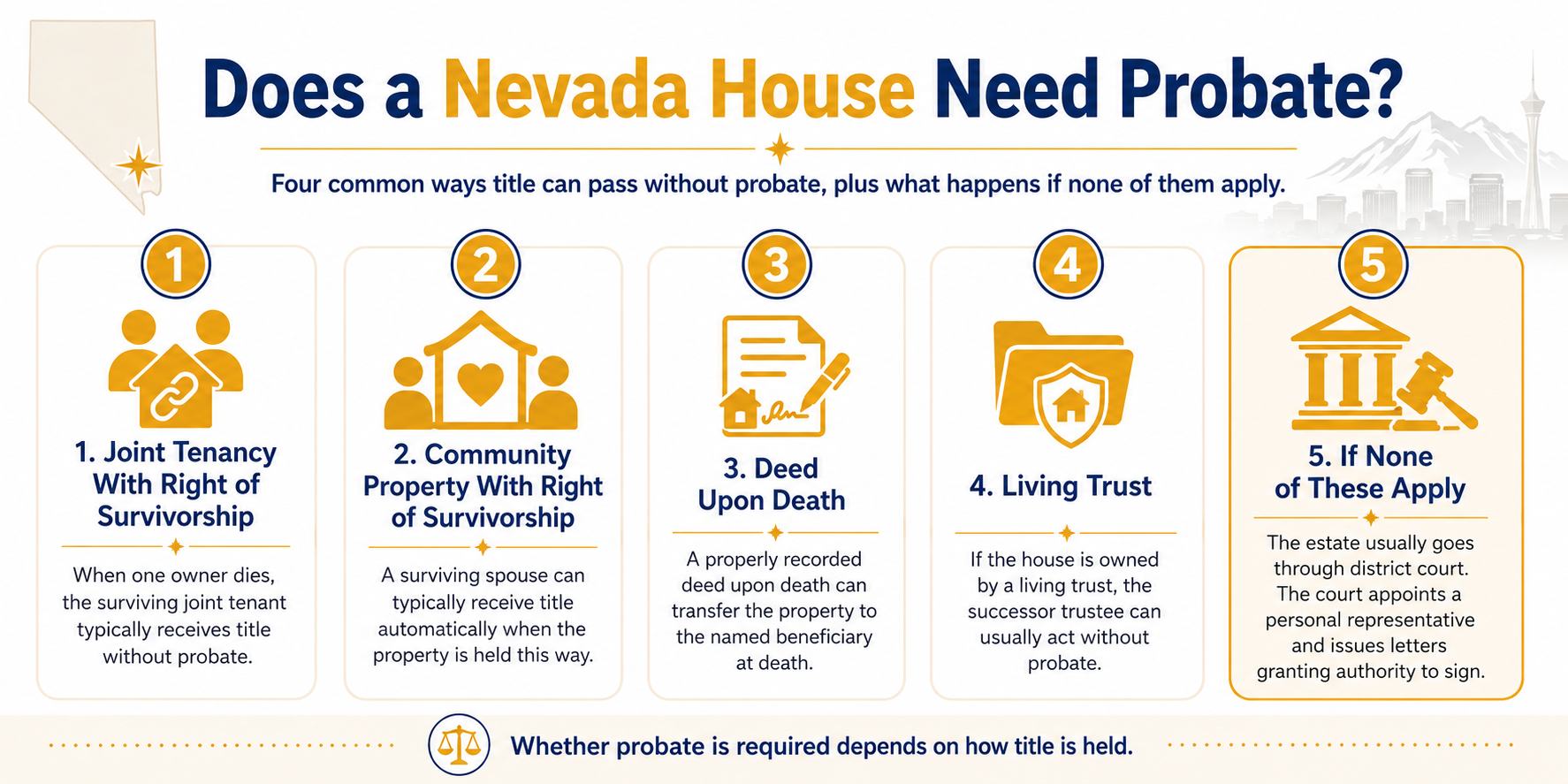
Joint tenancy with right of survivorship. If the deed says so, the surviving owner generally takes the property automatically. What is usually needed is recording a death certificate and an affidavit, not a probate case.
Community property with right of survivorship. Nevada is a community property state, and spouses often hold title this way. Same result: the survivor takes it without administration.
A deed upon death. Nevada allows a transfer on death deed recorded during the owner’s lifetime, which passes the property to the named beneficiary outside probate. If one was recorded, it is in the county records.
A living trust. If the property was deeded into a trust, the successor trustee has authority to sell under the trust document. No probate case is needed, though the title company will want the trust documents.
If none of those apply, the property is part of the estate and some form of court process is likely. That is normal and it is survivable.
How Nevada Probate Works
Probate runs through the district court in the county where the person lived. For most of our market that is the Eighth Judicial District Court in Clark County, or the Second Judicial District Court in Washoe County. The court appoints someone to act for the estate, usually called the personal representative or administrator, and issues letters confirming that authority. Those letters are what a title company will ask for before a sale can close.
Nevada also offers simplified paths for smaller estates. A “set aside without administration” under NRS Chapter 146 lets a court order assets distributed without a full administration when the net value of the estate falls under a statutory dollar limit. That limit has been raised several times, and figures published in older articles are routinely out of date, so check the current number rather than trusting any secondhand source including this page. The Nevada courts self-help center maintains the current thresholds and the forms.
Larger estates go through summary or general administration, which take longer and involve more hearings. Which track applies depends on the value of the estate, not on how complicated the family is.
Get An Offer Today, Sell In A Matter Of Days
When Several Heirs Own the House Together
This is the situation that stalls more inherited-property sales than any legal issue. Everyone with an ownership interest has to agree to sell and sign, and siblings rarely start in the same place. One wants to keep it. One wants it gone yesterday. One lives out of state and has not seen the house in years.
A few things that help. Get the numbers on paper before the conversation, because arguing about an unknown value is unproductive. Find out early who has authority to sign, since that is a legal question with an answer rather than a family question. And put a decision date on it. A vacant house costs money every month in taxes, insurance, utilities, and association dues, and that cost comes out of everyone’s share.
We work with families spread across several states regularly, most often on properties in Henderson, Las Vegas, and Reno. Documents can be signed remotely with a notary and funds wired to each party separately at closing, so nobody has to fly in or hand money to a sibling and trust it gets split.
What Usually Goes Wrong With an Inherited Nevada House
These are the recurring problems, and none of them stop a sale. They just need to be found early.
The insurance lapsed. Standard policies restrict coverage on vacant homes, and carriers often cancel after a death when nobody is living there. A vacant house in the desert with no active policy is a real exposure. Check this first.
The HOA kept billing. Assessments do not pause because someone died. Under NRS Chapter 116, part of a Nevada association lien sits ahead of the first mortgage, so a balance that accumulated over a year of probate matters to the payoff.
Property taxes fell behind. Common when the person managing bills was the person who died. These are paid from proceeds at closing rather than out of your pocket beforehand.
There is a reverse mortgage. These come due when the borrower dies, and the timeline the servicer gives heirs is short. If there is one on the property, that is the most time-sensitive fact in the whole situation.
The house is full. Decades of belongings, and nobody has the time or the heart to sort them. When you sell as-is to us, you take what matters to you and leave the rest. It is not a problem and it does not change the number.
Someone is living there. A relative, a tenant, or a caretaker. Tell us up front. It is workable, but it changes the plan and it is far better handled at the beginning than discovered later.
The maintenance stopped years ago. Roofs, HVAC systems, and plumbing that were deferred while someone was ill. This is ordinary for us and does not need fixing before a sale.

Estates frequently come with paperwork problems as well as property problems. If the deed, the heirs, or old liens do not line up cleanly, see selling a house with title problems in Nevada.
Your Options for the Property
Sell as-is for cash. Nothing gets repaired, cleaned out, or staged. This fits when the house needs work, when heirs are spread out, when the estate needs liquidity to settle debts, or when nobody wants to manage a property from another state while probate runs.
List it with an agent. If the home is in decent shape and the estate can carry the holding costs through a listing period, the retail market will usually net more even after commissions. That is a real answer and sometimes it is the right one. See how the four selling options compare.
Keep it and rent it. Viable if the heirs agree, the property is financeable, and somebody is genuinely willing to be a landlord. Long-distance ownership of a house nobody wanted is how a lot of the calls we take begin.
Buy out the other heirs. If one person wants the house and the others want cash, a buyout can work. It needs an agreed value and financing, and it is worth getting an independent valuation so the family agreement holds up later.
How a Sale Works With Us During Probate
We start by pulling the recorded documents to see how title is actually held, what liens exist, and whether a probate case has been opened. Then we look at the property and give you a written offer showing what would reach the estate at closing.
From there, the timeline follows the court rather than us. If letters have already been issued, things move at a normal pace. If the case is not open yet, closing waits on the appointment. We can hold an agreement through that period, and we do not charge anything for waiting. The offer does not shrink because the court took longer than expected, and we will not pressure you to sign something before you have authority to sign it.
The details of how we underwrite are on how we calculate our offers, and the step-by-step process is on how we buy houses in Nevada.
Our Priority Markets
We buy anywhere in Nevada. These are the communities we work in most often.
What We Cannot Do
- We cannot open or speed up a probate case. That is the court’s calendar and a probate attorney’s work, not ours.
- We cannot tell you who inherits. That comes from the will, the trust, or Nevada intestacy law, and it is a legal question for an attorney.
- We cannot mediate between heirs. We can put clear numbers in front of everyone, which sometimes helps. We are not a neutral party and we will not pretend to be.
- We cannot advise you on taxes. Inherited property has its own rules, including how the cost basis is treated. Ask an accountant before you decide anything, because that answer can be worth more than the difference between two offers.
- We cannot buy from someone without authority. If the court has not appointed a representative and title did not pass outside probate, no legitimate buyer can close. Anyone telling you otherwise is a reason to walk away.
Help That Is Not Us
- The Nevada courts self-help center publishes current small estate thresholds, forms, and plain-language instructions.
- The Civil Law Self-Help Center in Clark County walks through the set aside process step by step.
- A probate attorney, which is worth it for anything contested, anything with significant debts, or any estate where the heirs do not agree.
- The county recorder, where you can pull the deed and see exactly how the property is titled before anyone tells you what it says.
Questions About Selling an Inherited House in Nevada
Do I have to wait for probate to finish before selling?
Not usually. What is generally needed is authority to sign, which arrives when the court issues letters to the personal representative, not when the case closes. If title passed outside probate, no case is needed at all.
How long does Nevada probate take?
It depends on the size of the estate, the track it qualifies for, whether anyone contests, and the court’s calendar. A simplified set aside is materially faster than a general administration. Your probate attorney can give you a realistic estimate for your specific case, and we would rather you get that number from them than from us.
What if the house still has a mortgage?
It gets paid off through escrow from the sale proceeds, the same as any sale. Keep making payments if the estate can, because a default adds a foreclosure clock to a probate timeline and those two calendars do not coordinate.
Do all the heirs have to agree?
Everyone with an ownership interest has to sign. When a court-appointed representative is selling on behalf of the estate, the authority may run through that person instead. Which applies to you is a legal question worth asking an attorney.
Will I owe taxes on an inherited house?
Nevada has no state income tax, and inherited property has specific federal rules including how cost basis is treated. Talk to an accountant. This is one of the few questions where the answer genuinely changes the money.
The house is full of belongings. Is that a problem?
No. Take what matters to you and leave the rest. We handle the cleanout and it does not change the offer.
Can you buy if the estate has debts?
Often yes. Liens against the property are paid from proceeds at closing. Other estate debts are handled through the probate process itself, which is one reason selling can help: it converts a house nobody can use into money the estate can actually apply.
If You Want to Know What the House Is Worth to Us
Send the address and tell us where things stand, including whether a probate case has been opened. We will pull the recorded documents, look at the property, and give you a written number with no obligation and no fee. If the answer is that you should list it or wait, we will tell you that.
Get An Offer Today, Sell In A Matter Of Days
Request a cash offer here, call (702) 208-2434, or use the form. More answers are on our Nevada home selling FAQ. If you are early in the process and just trying to understand what you are dealing with, that is a good reason to call too.
Written by Kyle Newman, a second-generation real estate professional with family in the industry since 1977. Last updated August 14, 2026.
Sell My House NV is a tradename of United Homes of America LLC, a Nevada-registered company founded in 2015. We are a direct home buyer, not a law firm, not a licensed Nevada brokerage, and not a tax advisor, and nothing on this page is legal or tax advice. Probate statutes and dollar thresholds change, including recent amendments to Nevada’s small estate limits, so confirm current figures with the court, the Nevada courts self-help center, or your own attorney before relying on them.