
Can I sell a house in Nevada that has an HOA lien on it?
Yes. An association lien is a debt against the property, and debts against the property get paid out of the sale proceeds at closing. You do not have to clear it first and you do not have to bring money to the table to do it. What matters is knowing the real number early, because in Nevada an HOA balance affects a sale differently than it would almost anywhere else in the country.
Why Nevada HOA Liens Carry Unusual Power
In most states, a homeowners association lien sits behind the mortgage. If the association forecloses, the buyer takes the property subject to the loan, which limits how much leverage the association really has.
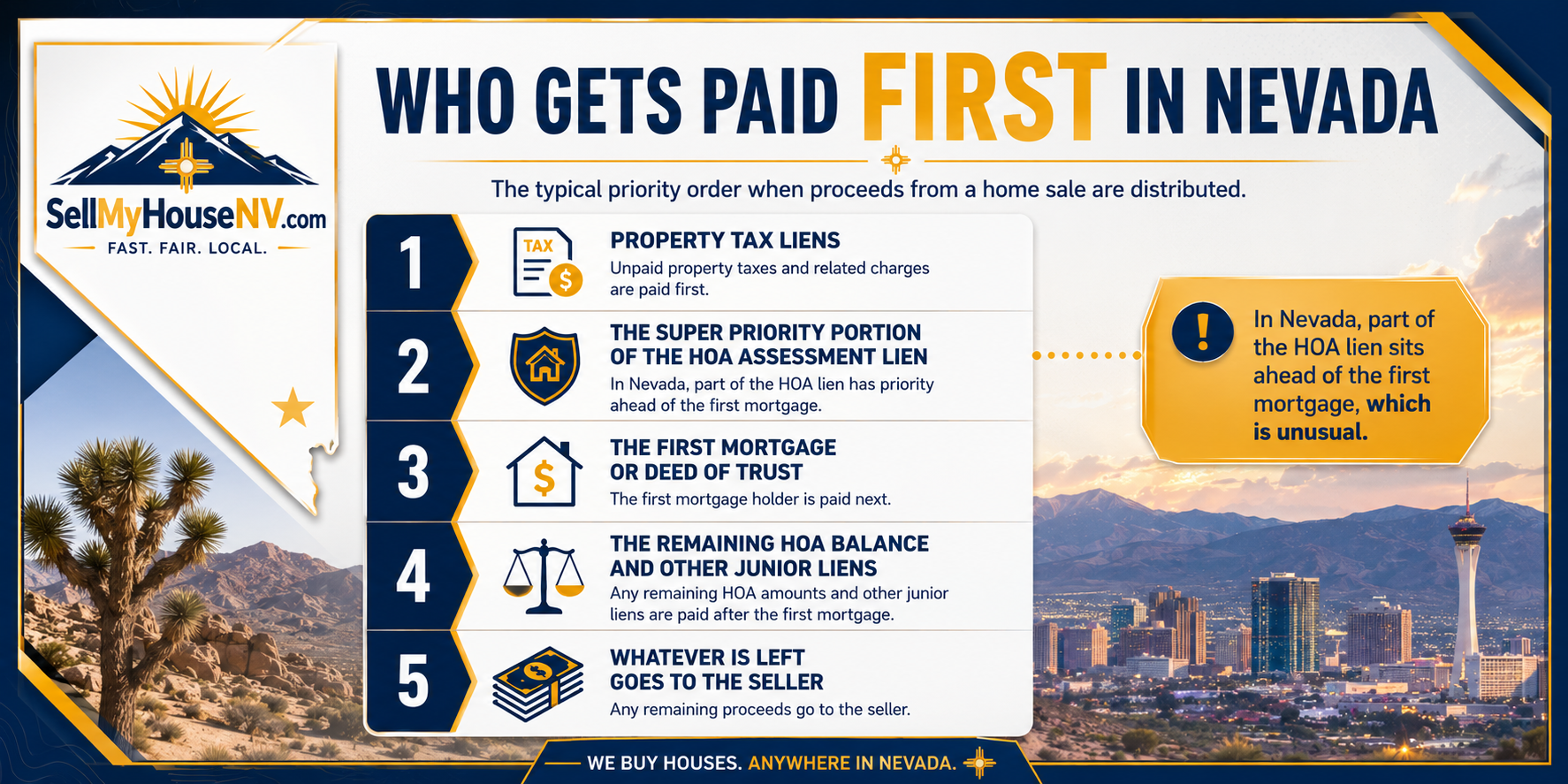
Nevada is different. Under NRS Chapter 116, a portion of an association’s assessment lien has priority over the first deed of trust. That portion is commonly called the super-priority piece, and it covers a limited window of unpaid assessments along with certain charges. The rest of the balance stays junior to the mortgage, but that super-priority slice is what makes Nevada associations genuinely powerful.
This is not a technicality. Nevada courts have addressed whether an association foreclosure can wipe out a first mortgage entirely, and the answer at various points has been yes under certain conditions. The legislature has amended Chapter 116 several times since to add notice requirements and protections for lenders. The practical takeaway for a homeowner has stayed the same throughout: your association has more leverage here than your neighbors in other states realize, and an unpaid balance is not something to leave sitting.
What an HOA Balance Does to Your Proceeds
At closing, the title company pays what is owed against the property before anything reaches you. The mortgage payoff, tax liens, judgments, and the association balance all come out first. Whatever is left is yours.
The part that surprises people is what the balance is actually made of. Sellers usually expect the unpaid assessments. What they do not expect is everything stacked on top: late fees, interest, fines for violations that accumulated while nobody was watching, collection agency costs, and attorney fees. It is common for the collection costs to exceed the original assessments. A balance a homeowner thought was a few months of dues can come back from the association as something several times larger.
Find out the real number before you agree to anything. Any offer that gets calculated on a guess about the HOA balance is a number that will change later, and that is the kind of surprise that kills deals in escrow.
Get An Offer Today, Sell In A Matter Of Days
How an HOA Collection Actually Progresses
The sequence varies by association and by management company, but the shape is consistent.
It starts quietly. A missed assessment, a late fee, then a second notice. Many homeowners are not really tracking it, especially when the property is vacant, tenant-occupied, or tied up in an estate.
It moves to a collection agency. This is where costs escalate, because agency fees and attorney fees attach to the debt and keep growing while nothing gets resolved.
A lien gets recorded. The association records a notice of delinquent assessment against the property with the county recorder. It is now public, and it is now attached to title, which means it has to be dealt with before ownership can transfer.
The association can move toward its own foreclosure. Nevada associations have the ability to foreclose on that lien, following the statutory notice requirements in Chapter 116. This is a separate process from anything your mortgage lender may or may not be doing.
Pull your own records rather than relying on what anyone tells you. The Clark County Recorder will show you exactly what has been recorded against your parcel and when.
Two Clocks Can Run at Once
This is the situation that catches people. An association foreclosure and a lender foreclosure are independent processes with independent timelines. Being current with your mortgage does not protect you from an association proceeding, and being current with your association does not slow down a lender.
If both are running, you are working against whichever calendar arrives first. See selling a house facing foreclosure in Nevada for how the lender side works, and check the recorded documents for both rather than assuming you know which is further along.
If You Think the Balance Is Wrong
Disputes happen, and some of them are legitimate. Fines get assessed for violations the owner never received notice of. Charges get applied to the wrong account. Collection costs sometimes look untethered from the underlying debt.
Ask for an itemized ledger in writing. Not a total. A line-by-line accounting showing assessments, late fees, fines, interest, and collection costs with dates. You are entitled to understand what you are being charged for.
Use the state’s process. The Nevada Real Estate Division houses the Office of the Ombudsman for Owners in Common-Interest Communities, which exists specifically to help homeowners with association disputes. Nevada also routes many common-interest disputes through alternative dispute resolution before they can go to court.
Do not simply stop paying while you dispute it. Interest and costs keep accruing on the disputed balance, and the collection process does not pause because you disagree with it.

Selling With the Lien Still in Place
You do not pay off the association before selling. Escrow does it at closing out of the proceeds, the same way it handles the mortgage payoff.
The practical constraint is paperwork, not money. Nevada sales involving an association require a resale package and a demand or statement of account from the association or its management company, and getting those documents is frequently the slowest part of the entire transaction. Management companies take their time, collection attorneys take longer, and none of them are in a hurry on your behalf.
Which is why we request them at the start rather than the end. If you are talking to any buyer about a property with an association balance, ask when they intend to order those documents. If the answer is vague, expect a delay they will later blame on the HOA.
How We Handle a Property With an Association Balance
We pull the recorded documents before making an offer, so a recorded notice of delinquent assessment shows up in our research rather than in escrow three weeks later. Then we ask the association for the actual figures instead of estimating them.
The balance affects what reaches you at closing, because it has to be paid. It does not change whether we will buy the property, and it does not need to be resolved before we make an offer. What we will not do is quote you a number that ignores the association and then reduce it once the real figure arrives. That is the most common way this situation gets used against sellers, and it is why the research happens first. The rest of our process is on how we buy houses in Nevada, and the reasoning behind the number is on how we calculate our offers.
Our Priority Markets
We buy anywhere in Nevada. These are the communities we work in most often.
What We Cannot Do
- We cannot negotiate your balance down. Some associations and collection firms will compromise on fees and some will not. That conversation is yours, or your attorney’s.
- We cannot make the association produce documents faster. We can order them early, follow up, and keep you informed. We cannot control their timeline.
- We cannot tell you whether a fine was properly assessed. That is a legal question about notice and procedure under Chapter 116, and the ombudsman’s office or an attorney is the right place for it.
- We cannot stop an association foreclosure by ourselves. A sale that pays the balance resolves it. Nothing about signing a contract with us pauses their process before that.
- We cannot promise the balance will not grow. Interest and costs accrue until it is paid, so a payoff quoted today is usually good only through a stated date.
Help That Has Nothing to Do With Us
- The Nevada Real Estate Division, which houses the Office of the Ombudsman for Owners in Common-Interest Communities and handles homeowner complaints about associations.
- Nevada Legal Services, for qualifying homeowners facing collection or foreclosure.
- Your association’s management company, which can usually produce a ledger faster than the collection firm can.
- An attorney who handles common-interest community matters, worth it when the balance is large or the fines are disputed.
Questions About HOA Liens and Selling
Do I have to pay the HOA before I can sell?
No. It is paid from the sale proceeds at closing, the same as a mortgage payoff or a tax lien.
What if the balance is more than my equity?
Then the numbers need looking at carefully before you do anything. Tell us early and we will show you where the sale actually lands rather than discovering it in escrow. There are still options in that situation, and pretending otherwise wastes your time.
Can my HOA really foreclose on my house?
Nevada associations do have the ability to foreclose on an assessment lien, subject to the notice requirements in Chapter 116. It is not a bluff, and it is separate from anything your mortgage lender is doing.
Why is the balance so much bigger than the assessments I missed?
Late fees, interest, fines, collection agency costs, and attorney fees all attach to the debt. Collection costs commonly exceed the assessments themselves. Ask for an itemized ledger so you can see what is what.
I inherited a house with years of unpaid dues. Now what?
Common, and workable. Assessments kept accruing through probate because nothing pauses them. The balance is paid from proceeds at closing. See selling an inherited house in Nevada for how authority to sign works, which is usually the bigger constraint.
Will an HOA lien show up on a title search?
A recorded lien will. Amounts that have accrued but have not been recorded yet still have to be paid, which is why the association’s own statement of account matters as much as the title report.
Can I sell to a buyer who says they will handle the HOA later?
Be careful. The balance follows the property, and a sale that does not resolve it properly can leave you in a worse position than before. Any legitimate buyer will address it through escrow with the association paid at closing.
Find Out Where Your Sale Actually Lands
Send us the address and tell us what you know about the association balance, even if that is nothing. We will pull the recorded documents, request the real figures, and show you in writing what would reach you at closing. No fee, no obligation, and no number that changes once the association responds.
Get An Offer Today, Sell In A Matter Of Days
Request a cash offer here, call (702) 208-2434, or use the form. More answers are on our Nevada home selling FAQ. If you want to compare this against listing the property first, that comparison is on four ways to sell your Nevada house.
Written by Kyle Newman, a second-generation real estate professional with family in the industry since 1977. Last updated August 14, 2026.
Sell My House NV is a tradename of United Homes of America LLC, a Nevada-registered company founded in 2015. We are a direct home buyer, not a law firm and not a licensed Nevada brokerage, and nothing on this page is legal advice. NRS Chapter 116 has been amended repeatedly and association practices vary, so confirm anything that affects your decision with the Office of the Ombudsman, your association, or your own attorney.